
Seeratul Mustafa
Shawwal 1446 AH
Publisher
Zam Zam Publishers
Language
Arabic
Category
Seerah
مؤلف الكتاب
Mawlana Idris Kandhlawi
مؤلف الكتاب
Mawlana Idris Kandhlawi
About the Book
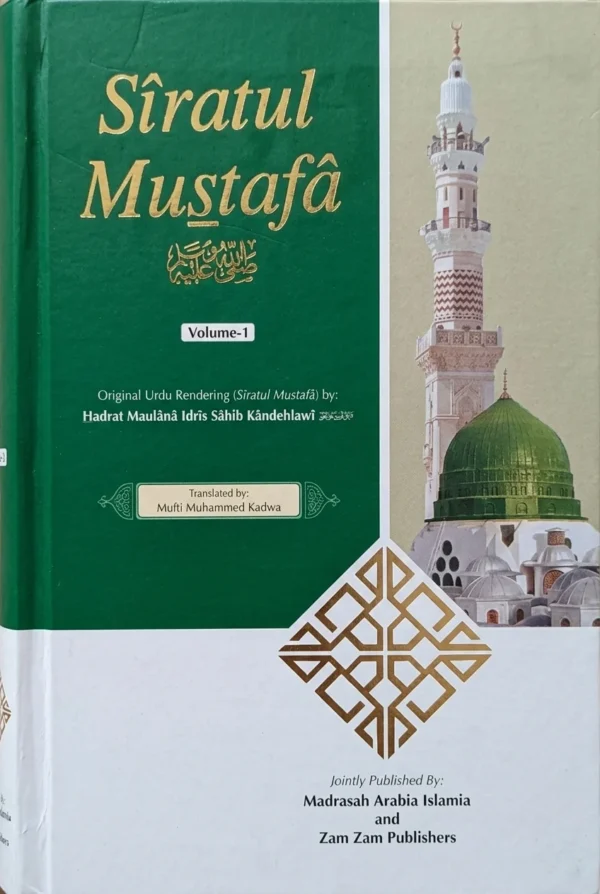
Seeratul Mustafa is amongst the best books written on Seerah. Written originally in Urdu by Mawlana Idris Kandehlawi and thereafter translated into English by Mufti Muhammad Kadwa and Mawlana Mahomed Mahomedy and published in three volumes by Madrasah Arabia Islamia and Zam Zam publishers.
This book stands out for a number of reasons going back to both the expertise of the author and the refined work that he has produced.
The Author:
Mawlana Muhammad Idris was known as Shaykh al-Hadith wal-Tafsir. Muhaddith al-‘Asr Sayyid Muhammad Yusuf Binnori referred to him as ‘Shaykh al-Muhaddithīn’. The value of this title can be gleaned from understanding the undisputed authority of Hazrat Binnori. Mawlana Idris was born in Bhopal, India in 1317 AH / 1900 CE. His father was amongst the descendants of Sayyiduna Abu Bakr RA whilst his mother was amongst the descendants of Sayyiduna ‘Umar RA. After completing the memorisation of the Qur’ān, he completed his initial studies from Madrasah Ashrafiyyah, Thanabowan. He graduated at the age of nineteen from Saharanpur and greatly benefited from the likes of Mawlana Khalil Ahmad al-Saharanpuri. Thereafter, he re-did his Dawrah al-Hadith at Deoband under the likes of Mawlana Anwar Shah Kashmiri, Mawlana Shabbir Ahmad Uthmani, and Mufti Aziz al-Rahman. He initially taught at Madarasah Aminiyyah, Delhi, and thereafter at Deoband as Shaykh al-Tafsir. He eventually migrated to Pakistan in 1949 and taught at Jami’ah Ashrafiyyah, Lahore. He passed away in 1394 / 1974 CE He has written extensively across multiple fields including Tafsir, Hadith, Kalam, Seerah, History and Politics. Amongst his most famous works is his Tafsir ‘Ma’ārif al-Qur’ān’ which has been published in 8 volumes.
The book ‘Seeratul Mustafa’:
Spanning three volumes, the author has expertly covered the various sciences related to the Prophet ﷺ. These include: the biography of the Prophet ﷺ (Seerah), his battles and expeditions (Maghazi), his inner qualities and physical appearance (Shamail), his Khasais, and his miracles (Dalāil al-Nubuwwah). In this arduous task, the author describes himself saying: “… on the one hand, committed himself to authentic references and reliable narrations whilst on the other hand, has somewhat strived to discuss a few underlying reasons and cognitive content as well.” Thus, highlighting the meticulous nature of his research in identifying the reliable narrations, corroborating the various reports, and finally deriving important points from this. Furthermore, his work is a treasure trove of the different sciences including Tafsir, Hadith and Hadith criticism, Fiqh, ‘Ilm al-Kalām, Tasawwuf, and much more. He has also taken the effort to refute incorrect ideologies and interpretations presented by the Orientalists and Modernists. Due to the above reasons, his book has stood out amongst other books on Seerah. It is important to know that the period in which this book was written was the period in which Pakistan was formed. For this reason, we find the author referring to nationalism and hinting to the opinions of the other ‘Ulama of the time. We also find at times, the author refuting ‘Allamah Shibli Nu’mani, the author of ‘Seeratun Nabi’, as this book had gained widespread acceptance and popularity throughout the subcontinent. Lastly, the only drawback of this edition is the horrible typesetting of the Arabic quotes throughout the book which are filled with mistakes. Similarly, many verses of poetry in Farsi and Urdu are not translated into English in the third volume. I’ll conclude with the words of Hakeem al-Ummah Mawlana Ashraf Ali Thanwi who writes about this book saying: ‘… the author certainly discharged all the vital aspects and necessary dues involved in the compilation of Seerah. A person who has basic knowledge of Urdu should not deprive himself of either teaching or studying this book’.
P.S. This book has been abridged into one large volume by excluding many of the academic discussions making it suitable for the average person.