
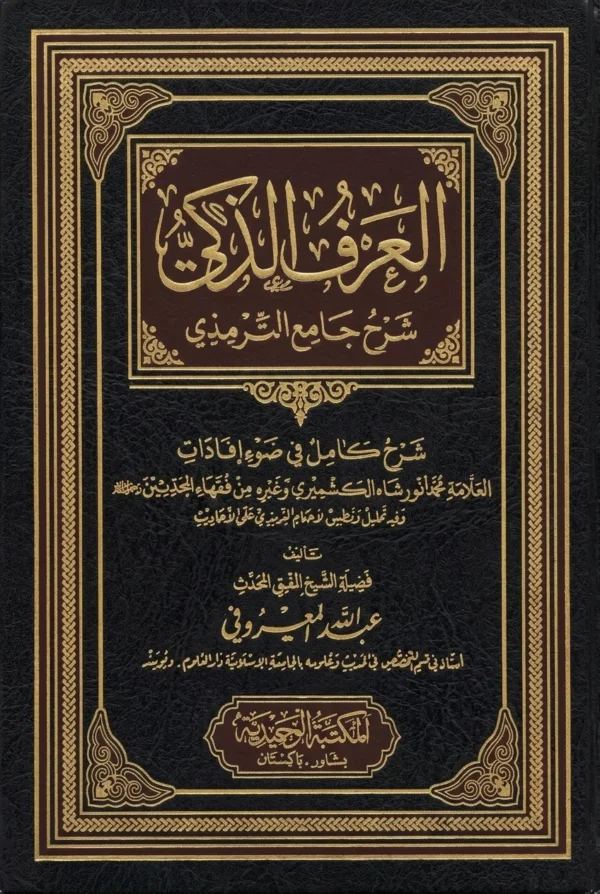
العرف الذكي شرح جامع الترمذي
Zul Hijjah 1446 AH
Publisher
Maktabah Ismaeel
Language
Arabic
Category
Fiqh
مؤلف الكتاب
Shaykh Abdullah
مؤلف الكتاب
Shaykh Abdullah
About the Book
With over 20 years of dedication and hard work, we finally have a complete 20 volume commentary by Shaykh Abdullah al-Ma’rufi on Imam al-Tirmizi’s al-Jami’, in light of the explanations of the ‘Ulama of Deoband generally and ‘Allamah Anwar Shah al-Kashmiri specifically.
✒️ The Author:
Shaykh Abdullah ibn ‘Umar ibn Basheer al-Ma’rufi was born in the year 1967 . He completed his Darse Nizami and Takhassus in Ifta and Fiqh from Darul Uloom Deoband.
Amongst his teachers are Bahr al-‘Ulum Shaykh Ni’matullah al-A’zami, Mufti Saeed Ahmad Palanpuri and Shaykh Arshad al-Madani.
He began teaching in the faculty of Hadith specialisation at Darul Uloom Deoband in 2001 and has been teaching Ibn Salah’s Muqaddimah for over 20 years. He currently teaches therein and oversees the theses written by the Takhassus students.
He has authored multiple works in Arabic and Urdu. Most notably his commentary on Jami’ al-Tirmizi: al-‘Arf al-Zaki and his commentary on Imam Bukhari’s al-Adab al-Mufrad.
📚 The Book:
The journey of this commentary began in 1419 AH when Shaykh Abdullah travelled to the Haramayn and was instructed by Shaykh ‘ Ashiq Ilahi al-Barni to compile such a commentary on Jami’ al-Tirmizi. This request came to fruition when Shaykh Anzar Shah al-Kashmiri , the son of ‘Allamah Anwar Shah al-Kashmiri, sent through some of the notes from his father’s lessons to Shaykh Abdullah so that he may begin working on them.
This commentary stands out from the various other commentaries compiling the explanations of ‘Allamah Kashmiri, as his son Shaykh Anzar Shah spent many years searching for his father’s students and collecting their notes from his lessons. These notes cover his lessons on Saheeh al-Bukhari, Jami’ al-Tirmizi and Sunan Abi Dawud. The author exerted himself in studying these notes and compiling them into one comprehensive commentary while also simplifying the complex concepts presented by ‘Allamah Kashmiri.
Shaykh Anzar Shah al-Kashmiri describes this commentary as: “ the most comprehensive book which presents the lessons of ‘Allamah Kashmiri”
Furthermore, the author also benefits greatly from the Shuruhaat and Hawashi of the ‘Ulama of Deoband such as the notes of Mufti Rashid Ahmad Gangohi and Shaykh al-Hind, Bazl al-Majhud of Shaykh Khalil Ahmad al-Saharanpuri, Awjaz al-Masalik of Shaykh Zakariyya Kandhelwi and many others. He has also referred back to many of the earlier commentaries and specifically to the books of Imam al-Tahawi in order to solve the apparent contradictions between the Ahadith.
Additionally, the Fiqhi Masaail presented by Imam Tirmizi have also been discussed in depth by first explaining the positions of the scholars, their evidences, and why the Hanafi opinion is given preference.
Another unique aspect of this commentary is that the author has gone to great lengths to explain the verdicts of Imam Tirmizi on the Ahadith . The Takhassus students at Deoband had previously carried out extensive studies on Imam Tirmizi’s verdicts such as Hasan, Hasan Saheeh and Hasan Ghareeb which were initially published individually in large volumes. These studies have since been integrated into this commentary and the first volume is largely dedicated to the explanation of these terminologies.
Lastly, the author has also provided the Takhreej of the Ahadith mentioned by Imam Tirmizi directly and those that he has referred to under ‘Wa fil Baab’. He has also added notes from his own teacher Shaykh Ni’matullah al-A’zami in the footnotes. Thus, making this a valuable commentary for both students and teachers alike.