
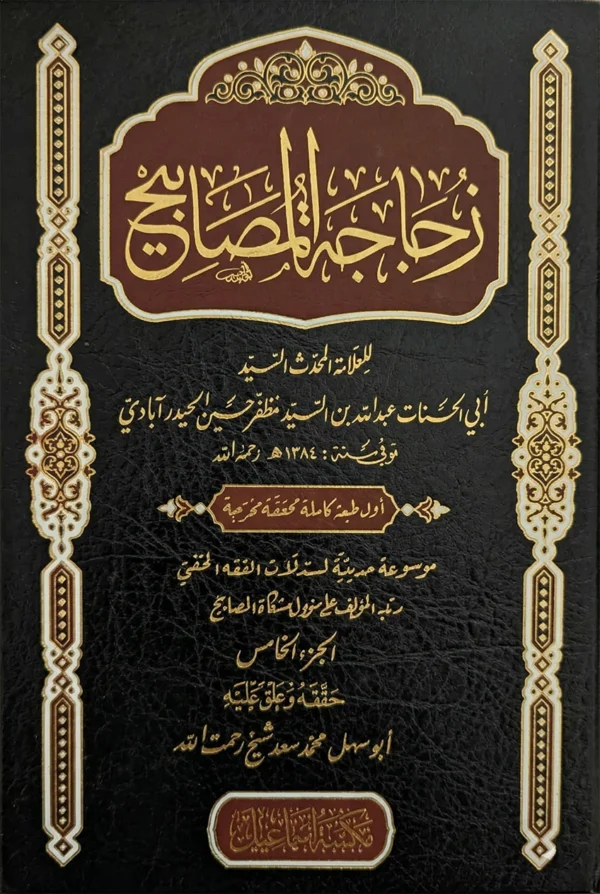
Zujajah al-Masabih
Safar 1447 AH
Publisher
Maktabah Ismaeel
Language
Arabic
Category
Fiqh
مؤلف الكتاب
Mawlana Abdullah Shah Naqshbandi
مؤلف الكتاب
Mawlana Abdullah Shah Naqshbandi
About the Book
Submission by Mufti Mohammad Jameel Hassan Saad
Mishkat Al-Masabih, compiled by the great Scholar Muḥammad ibn Abdi Allah Khatib at-Tibrezi, is an integral part of the Darse Nizami syllabus taught in the majority of the madaris. However, it poses a unique challenge to Hanafi Students as it is a compilation by a Shafi scholar to primarily provide proofs for the Shafi madhab, which creates a crises in the Hanafi students as they are exposed to a large quantity of Shafi proofs with little to no mention of Hanafi proofs, creating a sense of doubt or uncertainty regarding the origin and basis of the Hanafi school of Islamic jurisprudence.
Many scholars have attempted to rectify this issue, especially from the Indian subcontinent, by attempting to collect the textual proofs for the Hanafi school in various compilations, such as I’laa Us-Sunan, compiled by Mawlana Zafar Ahmed Uthmani, and Aathaar Us-Sunan, by Allamah Nimawi. However, each of these compilations has had issues of their own, the former being too long to be consulted by students, or to be taught side by side with Mishkat, or the latter remaining unfinished, therefore being unable to address several important chapters of Islamic jurisprudence.
However, by the grace of Allah subhanahu wa talaa, this unique challenged was met magnificently by the erudite scholar, the muhaddith of the Deccan, the Qutub of his era, Mawlana Abul Hasanaat Abdullah ibn Muzaffar Hussain Shah al-Husayni an-Naqshabandi al-Qadiri, In his Magnus opus ‘Zujajah tul-Masabih’.
The Author
Mawlana Abdullah Shah Naqshbandi, known as Muhaddith-e-Deccan, was born on 6 February 1872 in Husaini ‘Alam, Hyderabad. He received his religious education from distinguished scholars such as Mawlana Muhammad Anwarullah Faruqi, Mawlana Habibur Rahman Saharanpuri, Mawlana Mansur Ali Khan, and Hakim Abdur Rahman Saharanpuri (son of Mawlana Ahmed Ali saharanpuri).
He later became a disciple of Miskin Shah Naqshbandi, and after him, of Muhammad Badshah Bukhari, through whom he advanced in the Naqshbandi–Qadiri Sufi path.
A gifted scholar and teacher, he taught throughout his life at the Ali Aqa Mosque and authored many important works, the most famous being Zujajat al-Masabih, along with books such as Yousufnama, Merajnama, Miladnama, and Qiyamatnama.
Among his notable students were his sons and descendants who continued his spiritual lineage. He passed away in 1964 (18 Rabi‘ al-Thani 1384 AH) and is buried at Naqshbandi Chaman, Misri Gunj, Hyderabad.
His Sanad for the Kutub Sittah is as follows:
Mawlana Abdullah Shah (The author):
- Mawlana Hakim Abdul Rahman al-Saharanpuri
- Mawlana Muhaddith Ahmad Ali saharanpuri
- Shah Ishaq Dehlawi
- Shah Abdul Aziz Dehlawi
- Shah Waliullah Dehlawi
The Book
Zujajatul Masabih is compiled on a similar pattern as Mishkaat al-Masabih, gathering proofs and evidence for the Hanafi madhab, except that the chapters are not divided into three subsections. This helps the students to dispel any and all doubts regarding the authenticity of the Hanafi Madhab, and to prove indubitably that the Hanafi madhab is entirely grounded in the Quran and Prophetic traditions. It can be taught side by side with Mishkaat ul-Masabih, or in its place. It can also be read and taught in the circles of tasawwuf and tazkiyah, as has been done with Mishkaat ul-Masabih, and as the author himself had done.
That said, not all of the narrations mentioned are of the same strength, some even being considered munkar, therefore a thorough tahqeeq and verification of the narrations was needed. This task was painstakingly fulfilled by Mawlana Muhammad Saad Sheikh Rahmatullah who diligently researched, referenced and graded every narration in the book, which was then beautifully printed by Maktabah Ismaeel from Britain.
To conclude, Zujujatul Masabih is an indispensable resource for students, scholars and researchers alike, and should be present in every muslim’s house.
Note: Specifics of the review have not been fact checked by Hilm Books