
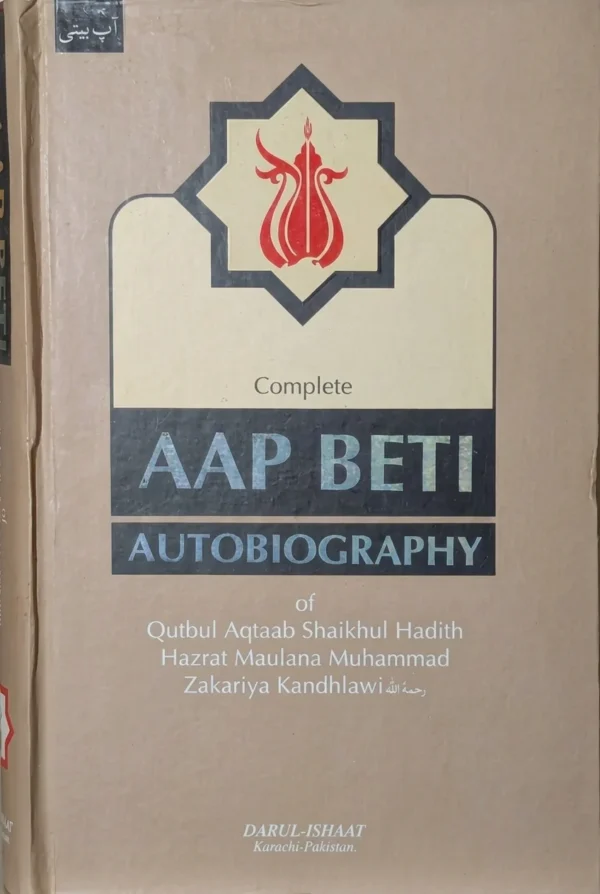
Aap Beti
Rajab 1447 AH
Publisher
Darul Ishaat
Language
English
Category
Miscellaneous
مؤلف الكتاب
Zakariyya Kandhelwi
مؤلف الكتاب
Zakariyya Kandhelwi
About the Book
Written by: Year 2 ‘Alimiyyah student (Y10)
✍️ The reason I bought this book was because I wanted to read the autobiographies of the great Ulama of this Ummah. Who else was there to start with other than Shaykh al-Hadith Mawlana Zakariyya Khandelwi. I had originally bought this book a few years ago, but the flavor of the book is such that even after finishing it, you still want to taste it again. I then found Shaykh Qasim selling it at Hilm Books and I purchased it again there. The book goes through the life of Hazrat Shaykh from his upbringing, his studies, his habits and other details. Reading it inspires the reader to taste the same fervor as these Ulama.
📚 Context of the book:
Hazrat Shaykh had originally written the book as a reply to a chapter written about him in “Sawanih Yusuf” by Mawlana Abul Hasan Ali Nadwi.
Hazrat Shaykh felt that the chapter missed out important points of benefit and what should not have been written was penned. This led him to write his own version, one which has been of benefit to multitudes of readers.
The book is divided into 7 volumes. They start from his tarbiyah at the hands of his father and his 60 years of contact with Mazahirul uloom which includes his student and teaching days. The book continues and narrates events of benefit from the life of his elders. It also includes narration of the partition of India and his hajj journeys with other great ulama
The Author:
Qutb al-Aqtaab Shaykh al-Hadith Hazrat Mawlana Muhammad Zakariyya ibn Yahya al-Kandhelwi al-Siddiqi al-Muhajir al-Madani is a great Alim of the recent past, one whose works can be found from Morocco all the way till Bangladesh.
Birth
He was born at 11 pm on the 11th of Ramadan 1315 AH corresponding to 2 February 1898. He was born in Kandhla located in Uttar Pradesh modern day India which at the time was part of the British Raj. Kandhla is his family’s ancestral village. He was born into a family of great scholars who trace their lineage back to the great Sahabi Abu Bakr RA.
His father was a great Aalim and a close assistant of Shaykh Rashid Ahmed Gangohi. His uncle, Mawlana llyas Kandhlawi was also a great Aalim who studied at Darul Uloom Deoband and founded the Tablighi Jamaat whose effect everyone has felt.
🏫 Studies
Hazrat Shaykh originally started his studies of Quran a bit later than what was considered the norm at the time, something which would greatly anger his grandmother. He started his studies in Gangoh which is where his family was residing as his father was an attendant of Hazrat Gangohi over there. He started his Qaida Baghdadiyyah at around the age of 7-8 at the hands of the wife of Hakim Abdur Rahman of Muzaffarnagar.
After finishing that he started Hifz with his father in which he would be required to recite each page 100 times. In this manner he completed his Hifz and started his elementary studies of Farsi etc.
During Rajab 1328 Hazrat Shaykh started his ‘Alimiyyah studies at Mazahirul Uloom Saharanpur. Up until then he had only learnt Farsi and elementary Arabic with his uncle. During Ramadan, there used to be no break but rather additional books which could not be studied during the year were studied then. His father used to make him memorize all the Nahwu rules and practise them on rough paper.
Hazrat Shaykh’s full curriculum and all the books he studied from year 1 till year 9 are mentioned in Aap Beti. His father’s way of teaching was such that al-Kaafiyah would be studied at night and Hidayat al-Nahwu in the morning, as if they were preparations for each other. Same for Quduri and Kanz.
His father had a special rule of not allowing the study of hadith to be at anyone’s hand except himself and Hazrat Khalil Ahmed Sahranpuri.
📝 Writings
According to Muhammad Shahid Saharanpuri, his written works amount to 103, of which 42 have been published and 61 remain unpublished.
He has written:
2 books on Tafsir.
60 books on Hadith.
4 books on Fiqh and Usul al-fiqh.
22 books on Tareekh and Seerah.
2 books on Tajweed and Qira’ah.
3 Books on Arabic Grammar, classical Logic, and Geometry. 3 books on Suluk and Ihsan.
4 books in defense of Islam and 3 books on miscellaneous subjects.
The most well known of these works are:
Awjaz al-Masaalik – Voluminous commentary on Muwatta Imam Malik
Fazail A’maal and Fazail Sadaqaat.
Hajjat al-Wada wa Umrat al-Nabi – A work in relation to the Nabi SAW’s final Hajj.
Akabir Ulama Deoband – A book in relation to the elders of Deoband
Al-I’tidaal fi Maratib al-Rijal – A book in regards to Ikhtilaaf between people and the middle path.
Death
Shaykh Zakariyya fell ill on Sunday 16 May 1982 in Medina. His condition deteriorated a week later resulting in serious breathing problems on Monday 24 May. The Shaykh passed away on Monday and was given Ghusl before maghrib and his burial took place after Isha on the same day. The funeral praver was led by the Imam of the Prophet’s Mosque, Shaykh Abdullah al-Zahim, and his blessed body was taken for burial in the nearby Jannatul Baqi’. His wish was to be buried close to the Prophet’s family members and as per his wish, his grave was dug just outside their enclosure.
May Allah swt allow us to follow in the footsteps of the great Ulama and to taste the same fervour as them and accept us for his deen.
Note: Specifics of this post have not been fact checked by Hilm Books.